
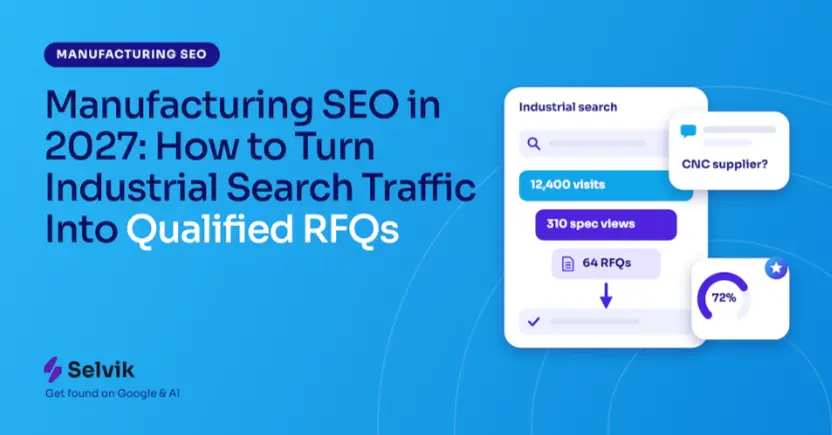
Manufacturing SEO helps industrial companies attract buyers searching for specific products, production capabilities, materials, and suppliers. However, generating website traffic is not enough. The real objective is to convert relevant search visibility into qualified requests for quotation (RFQs), distributor enquiries, and long-term business opportunities.
For manufacturers targeting the USA and Canada, an effective SEO strategy combines technical optimisation, capability-specific landing pages, product information, AI search visibility, and conversion-focused website design.
This guide explains how manufacturers can improve organic visibility and attract buyers who are closer to making purchasing decisions.
Why Manufacturing SEO Needs a Different Approach in 2027
Industrial buyers rarely search like ordinary retail customers.
Procurement managers, engineers, and purchasing teams often search using technical specifications, manufacturing processes, material grades, certifications, and production requirements.
For example, a buyer may search for “precision CNC machining for aluminum components” rather than simply “manufacturing company.”
These detailed searches can reveal stronger purchasing intent.
A manufacturing SEO agency should therefore prioritise technical relevance, commercial intent, and measurable enquiries rather than broad traffic growth.
Businesses can explore SEO services from Selvik Technologies to understand how technical optimisation, content, and search visibility fit into a broader growth strategy.
1. Target Keywords That Attract Industrial Buyers
Effective SEO for manufacturing companies begins with understanding how procurement professionals discover suppliers.
Keyword research should distinguish between general information searches and supplier-selection searches.
| Keyword category | Example search | Buyer intent |
| Manufacturing process | Precision CNC machining services | Commercial |
| Product-specific | Stainless steel industrial valves supplier | Commercial |
| Application-based | Custom automotive metal components | Commercial |
| Location-specific | Contract manufacturing company USA | Supplier discovery |
| Technical research | CNC milling vs CNC turning | Informational |
Manufacturers should develop individual pages for genuinely distinct services and capabilities.
Avoid creating multiple pages targeting identical keywords with slightly different wording.
Each page should address a specific buyer requirement.
2. Build Capability Pages That Generate RFQs
A common weakness in industrial websites is insufficient technical information.
Potential buyers need more than statements about quality and experience.
High-value manufacturing pages should clearly explain:
- Available manufacturing processes
- Supported materials and specifications
- Relevant industrial applications
- Production and equipment capabilities
- Verified certifications and quality controls
- Customisation options
- Quotation submission requirements
Where appropriate, manufacturers can publish downloadable technical documents and authentic facility photographs.
These details help visitors determine whether the supplier can meet their requirements before initiating contact.
3. Optimise Manufacturing Websites for Technical SEO
Technical SEO allows search engines to discover, interpret, and index relevant pages.
Manufacturing websites frequently contain product catalogues, technical PDFs, images, and complex navigation structures.
An industrial SEO audit should examine XML sitemaps, canonical tags, indexing rules, internal linking, mobile usability, and page performance.
Product and service pages should have unique titles, descriptive headings, and relevant structured data where supported.
A technically sound website also needs practical user navigation.
Selvik offers website design and development services that can support businesses seeking improved website structure and usability.
4. Prepare Industrial Content for AI Search
AI-powered search experiences have increased the importance of clear, accurate, well-structured information.
Manufacturers should publish content that answers real technical and purchasing questions.
Useful topics include material selection, manufacturing tolerances, production methods, quality inspection, and applications.
Strong industrial content may include:
- A direct answer to the search question.
- Clearly labelled technical specifications.
- Comparison tables explaining practical differences.
- Original photographs or diagrams.
- Relevant documentation and credible references.
AI search optimisation does not guarantee citations in AI-generated answers.
However, accurate, accessible content can improve how effectively both users and search systems understand a manufacturer’s capabilities.
5. Use Geographic SEO to Reach USA and Canada Buyers
Industrial manufacturers targeting North American markets should create content around genuine service coverage and buyer requirements.
Geographic SEO may involve dedicated country pages, regional delivery information, supported currencies, shipping capabilities, and applicable standards.
For example, a manufacturer supplying components to Canadian companies may explain relevant product requirements and confirmed shipping arrangements.
Location pages should provide distinct, useful information rather than simply replacing city names.
Avoid claiming local offices or manufacturing facilities that do not exist.
6. Convert Organic Visitors Into Qualified Enquiries
An effective manufacturing website should make quotation requests straightforward.
A dedicated RFQ form may ask for product type, required material, quantity, technical drawings, specifications, and delivery location.
Not every field needs to be mandatory.
Manufacturers should balance enquiry qualification against unnecessary form complexity.
Clear contact information, relevant certifications, transparent capabilities, and realistic production information can also strengthen buyer confidence.
The objective is to help procurement teams submit meaningful enquiries without unnecessary friction.
7. Measure Manufacturing SEO Through Revenue Opportunities
Organic sessions and keyword rankings are useful indicators, but they do not establish commercial success.
Manufacturers should evaluate whether SEO contributes to genuine business opportunities.
Manufacturing SEO Performance Metrics
| KPI | Why it matters |
| Qualified RFQs | Measures relevant purchasing enquiries |
| Organic conversion rate | Evaluates enquiry generation |
| Capability-page visibility | Tracks commercially relevant rankings |
| Lead quality | Identifies suitable potential buyers |
| Sales-qualified opportunities | Connects SEO with sales activity |
| Closed-won revenue | Measures attributable business outcomes |
Where possible, connect website conversion tracking with the company’s CRM.
This allows marketing and sales teams to assess lead quality beyond the initial website visit.
How a Manufacturing SEO Agency Can Help
Industrial companies often require a combination of technical SEO, content development, website optimisation, and conversion tracking.
An experienced manufacturing SEO agency should understand long B2B purchasing cycles, technical terminology, and the importance of supplier credibility.
Selvik Technologies positions its digital marketing services around industry-specific growth, including manufacturing businesses seeking qualified RFQs.
Its wider digital marketing capabilities include SEO, AI search visibility, website development, and conversion optimisation.
Manufacturers should evaluate any agency against their specific market, technical requirements, budget, and measurable commercial goals.
Manufacturing SEO Services from Selvik Technologies
Selvik Technologies Pvt. Ltd. is an Ahmedabad-based digital marketing and website development company serving businesses in India and international markets.
Its website identifies manufacturers among the industries it supports, with a focus on organic visibility and qualified lead generation.
Companies planning manufacturing SEO campaigns can discuss their website performance, target markets, product categories, and enquiry-generation objectives through Selvik’s contact page.
Business address: B 706, PNTC, Radio Mirchi Road, Ahmedabad, Gujarat 380015, India.
Email: hello@selvik.co
Phone: +91 9712155176
Frequently Asked Questions
What is manufacturing SEO?
Manufacturing SEO is the process of improving a manufacturer’s visibility in organic search results for relevant products, industrial services, and supplier-related searches.
How is industrial SEO different from regular SEO?
Industrial SEO places greater emphasis on technical specifications, manufacturing capabilities, B2B purchasing intent, and qualified enquiries.
How long does manufacturing SEO take to generate leads?
Results depend on competition, website condition, search demand, and implementation quality. Meaningful improvements commonly require several months, although individual pages may show changes sooner.
Can manufacturing SEO generate international enquiries?
Yes. Relevant technical content and geographically appropriate pages can help manufacturers reach international buyers, but actual results depend on market demand and supplier competitiveness.
What should manufacturers expect from industrial SEO services?
A suitable strategy should include keyword research, technical audits, capability-page optimisation, relevant content, conversion tracking, and performance reporting.
Conclusion
Manufacturing SEO in 2027 should focus on attracting the right industrial buyers rather than simply increasing website traffic.
By combining technical content, search-friendly capability pages, geographic relevance, and effective RFQ conversion pathways, manufacturers can create stronger opportunities for organic lead generation.
For businesses targeting the USA and Canada, Selvik Technologies offers SEO and digital growth services aligned with qualified lead acquisition.
